How to Cut Your OPD Time Without Cutting Care
- The problem is never just the clock
- Where your fifteen to twenty minutes actually go
- The consultation is not the whole treatment
- Introducing Visit Sequencing
- What belongs in the room, and what belongs to the system around it
- The arc behind a well-sequenced patient journey
- The pulmonologist who thought the problem was his patients
- What changes once the sequence is right
- Where to begin this week
- Questions doctors ask me about this
Every doctor I coach tells me the same thing early in our first conversation, almost in the same words. There is not enough time in the day.
Then I ask what they would do with ten more minutes for every patient. Most pause. A slower pace, usually. More explanation, maybe. Rarely a plan for what those extra minutes would repair.
Doctor, think about this. If the shortage were only about minutes, a longer OPD slot would fix it on its own. Hospitals that lengthen the slot rarely see that result. Something else decides whether a consultation works, and it is not the clock on the wall.
This pillar is about that something else. Not how to see patients faster. How to design the fifteen to twenty minutes you already have, and the days that surround them, so that less of your effort disappears before it reaches the patient.
The problem is never just the clock
Ask a hundred doctors what they need most and a large share will say the same word. Time. More of it, specifically inside the consultation.
I used to accept that answer at face value. Then I watched what happened when a doctor was given more time, not less. A longer slot filled with the same pattern of repetition, reassurance and correction that the shorter slot had carried. The extra minutes bought a little more comfort. They rarely bought more clarity.
That told me something useful. Much OPD time pressure is not a shortage of minutes. It is a shortage of sequence. The minutes exist. They are spent on the wrong things, in the wrong order, because nobody designed the order on purpose.
Where your fifteen to twenty minutes actually go
Sit beside a busy OPD for a full day and the same few activities repeat inside almost every slot, across almost every clinic I have studied. Re-explaining something said at the last visit. Reassuring a patient who is not asking a clinical question but an emotional one. Correcting a plan that was not followed. Deciding something routine that could have been decided before the patient even sat down.
None of this is wasted in the sense of being unnecessary. Each piece is responding to a real gap. Each piece is also a sign that something should have happened earlier, outside the room, and did not.
| What eats the minutes | What it is responding to | When it should have happened instead |
|---|---|---|
| Re-explaining the plan | Something explained once, not retained | Before this visit, in written or structured form |
| Reassurance about progress | Uncertainty about the pathway, not doubt about you | Built into the plan from the first visit |
| Correcting a missed step | A missing checkpoint between visits | Between visits, through a structured touchpoint |
| Deciding something routine | A decision that rarely needed your training specifically | Before the consultation, by a team member or a protocol |
I have written before about the three invisible leaks that drain a practice quietly, and the first of them, the Attention Leak, shows up here directly. Instructions given once do not reliably survive until the next visit, and re-explaining them is where many of your unplanned minutes go.
The consultation is not the whole treatment
Here is a sentence I return to with almost every doctor I coach. The consultation happens in your environment. The treatment happens largely in the patient’s environment.
Fifteen to twenty minutes is what most Indian consultations last. The rest of the week, the medication timing, the diet, the follow-through on instructions, happens somewhere you are not. What happens to the patient between two consultations decides more of the outcome than what happens inside either one.
This is why trying to solve OPD time pressure only inside the room has a ceiling. You can sequence the room well and still lose time if nothing supports the patient once they leave it. I have written separately about the behavioural side of that gap in the pillar on Habit-Based Treatment. Patient Journey Design is its sibling. One asks what sustains behaviour between visits. The other asks what should happen, and in what order, across the visits themselves.
Introducing Visit Sequencing
Once I started mapping where the minutes went, a pattern emerged across almost every practice I studied, regardless of specialty. The calmer OPDs were not seeing fewer patients or spending less time per patient. They were doing things in a specific order, often without the doctor realising an order had formed at all.
I eventually named that order Visit Sequencing. It has five parts, and each one, skipped, costs you time somewhere further down the line.
| Sequence step | What it means in the room | What skipping it costs you later |
|---|---|---|
| Education before expectation | Explain the condition and the plan before asking the patient to expect a result | The same questions return at every visit, each one needing a fresh explanation |
| Stabilization before optimization | Make the basics steady before chasing a more advanced target | Chasing optimisation on an unstable base forces constant correction visits |
| Compliance before escalation | Confirm the current plan is being followed before adding to it | Escalating on top of a plan nobody followed means unwinding two steps instead of one |
| Measurement before pricing depth | Only once something is measured does a conversation about a deeper, more involved level of care make sense | A conversation about premium care with no measured baseline has nothing concrete to point to, so it runs long and still fails to persuade |
| Trust before advanced protocol | Anchor the patient’s sense of the pathway before asking more of them | A demanding protocol introduced too early gets questioned at every step, and every question is an unplanned minute |
None of these five steps asks you to work faster. Each one asks you to do the right thing earlier, so a later visit does not have to pay for something an earlier one skipped.
What belongs in the room, and what belongs to the system around it
A consultation slot is not one kind of time. Some of it needs your clinical judgement specifically. The rest needs structure, and structure does not need to wait for you.
What needs your judgement
Diagnosis. Deciding the plan. Adjusting for a complication. The conversation that genuinely needs your training and your experience. None of that should be rushed, and none of it should be handed to anyone else.
What needs structure instead
Collecting a history that follows the same shape every time. Confirming what was followed since the last visit. Explaining a routine instruction for the third time. Much of this can live outside the room entirely, in a team member’s hands, in a written protocol, or in what I call technology as a silent assistant, a system that supports the patient between visits without demanding the patient’s attention or yours.
| Needs your judgement | Needs structure instead |
|---|---|
| Diagnosis and complications | Routine history collection, taken the same way every time |
| Adjusting the treatment plan | Confirming what was followed since the last visit |
| The one conversation only you can have with this patient | A routine instruction being repeated for the third time |
The mistake I see most often is treating all consultation time as equally yours to spend. It is not. The doctor who protects the judgement-only minutes and hands the rest to a team or a system gets a shorter, calmer OPD without seeing fewer patients.
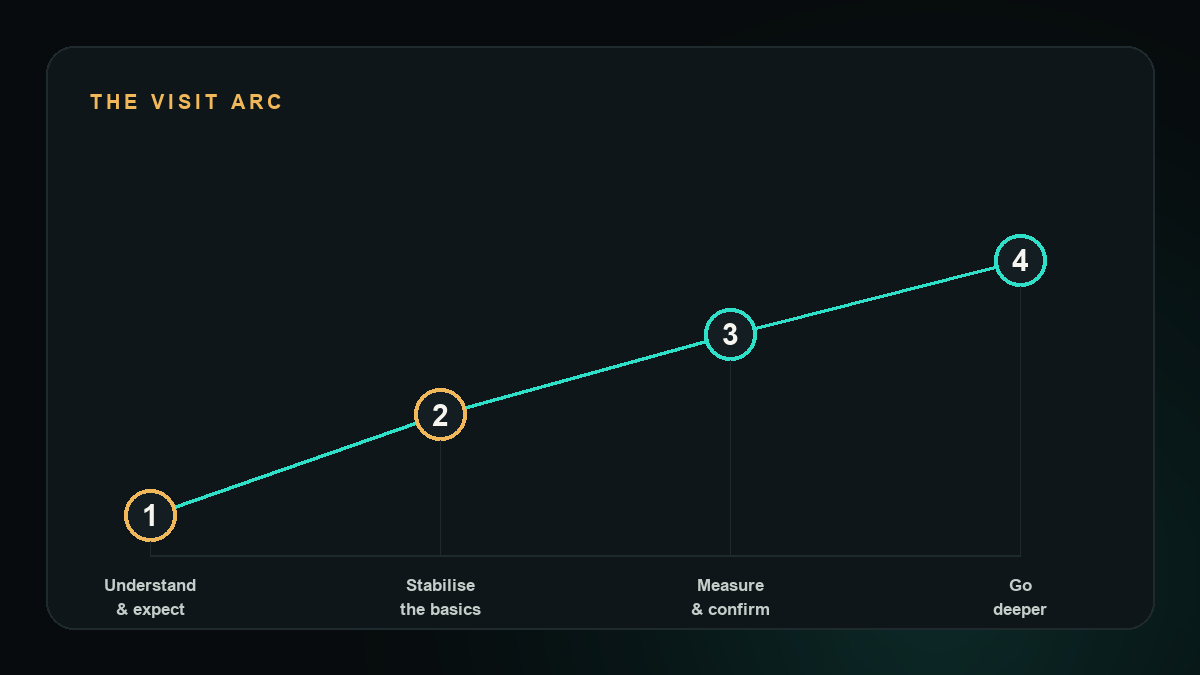
The arc behind a well-sequenced patient journey
A patient’s relationship with your practice is not one visit. It is a sequence of them, and the sequence has a shape, whether you designed it on purpose or not.
Why the first visit decides more than it seems
A first visit that tries to decide everything at once runs long and still leaves gaps, because there has not been room to also stabilise, measure and build trust inside the same fifteen minutes. A first visit that focuses mainly on understanding the patient and setting expectations, leaving optimisation for later, uses that early time differently, and buys calmer time afterward.
I will walk through exactly what belongs in each of the first several visits, visit by visit, in a dedicated piece. What matters here is the shape, not yet the detail. Visits that try to do everything immediately cost more total time across the relationship than visits that do the right thing at the right stage.
Every visit tries to fully resolve the problem. Decisions, education and reassurance arrive together, inside the same fifteen minutes, each time. Each visit runs over, and the next one inherits the same backlog.
Each visit does the one or two things that stage needs. Education comes early. Stabilisation comes before optimisation. By the fourth visit, there is a measured baseline to work from instead of a guess.
The pulmonologist who thought the problem was his patients
I worked with a pulmonologist running a high volume OPD of asthma and chronic obstructive pulmonary disease patients in a metro hospital. Inhaler technique came up in nearly every consultation, because poor technique is one of the most common reasons a correctly prescribed inhaler fails to work.
He had a reasonable response to that. He explained technique carefully, with a physical demonstration, at every visit. Consultations ran long because of it, and he accepted that as the cost of doing it properly.
The frustration was that technique still slipped between visits. Patients who had demonstrated correct technique in his room reverted to their old habit at home within weeks, and the next visit repeated the same demonstration from the beginning.
“I was teaching the same lesson at every visit and calling it thoroughness. It was not thoroughness. It was a missing checkpoint.”A Pulmonologist, After Reviewing a Quarter of Repeat Demonstrations
We moved the first demonstration earlier, before his own consultation, into a short structured session with a trained nurse, following the education-before-expectation step of Visit Sequencing. His own room time shifted to checking the technique rather than teaching it from zero, and a simple follow-up call at the two week mark, owned by someone other than him, caught the slip before the next visit instead of during it.
His consultations shortened. Correct technique held longer between visits. Neither change asked him to explain faster. Both changed where the explaining happened.
What changes once the sequence is right
The change is rarely dramatic in the first week. It is more visible over a full quarter.
Consultations get shorter, not because less happens, but because less has to be repeated. Patients arrive already informed instead of arriving to be informed for the first time inside a rushed slot. Correction, when it is needed, happens on a smaller problem caught earlier, rather than a larger one caught late.
None of this removes the need for your judgement. It removes the need for your judgement to also carry the weight of tasks that often did not need it.
- Which activity eats the most unplanned time in my own OPD: re-explaining, reassuring, or correcting?
- What decision happens inside my consultation that a team member or a protocol could make before the patient sits down?
- If I mapped my own patients’ first few visits honestly, would I find a sequence, or the same visit repeated several times?
Where to begin this week
Do not redesign the whole patient journey at once. Pick the one activity from the table earlier in this piece that costs you the most unplanned minutes, and move it outside the room this week. Nothing else.
I should be transparent about the timeline. A single activity can move outside the room within a few weeks of deciding to do it. Rebuilding the full sequence across every visit, with a team that holds it even when you are not watching, is closer to eighteen to twenty four months in my experience. Early relief arrives much sooner. Early relief and a fully redesigned journey are not the same thing, and I would rather say that plainly than let you expect the shorter timeline.
Your expertise should scale. Your exhaustion should not.
Questions doctors ask me about this
Does cutting OPD time always mean lower quality care?
Not if the time removed was unplanned repetition rather than judgement. Most of the minutes this piece talks about were rarely adding clinical value. They were compensating for something that should have happened earlier, or outside the room.
How is Visit Sequencing different from running a tighter schedule?
A tighter schedule asks you to do the same things faster. Visit Sequencing asks you to do the right thing at the right stage, so later visits are not paying for something an earlier one skipped. The time saving comes from the order, not from speed.
Can a single doctor clinic apply this, or does it need a large team?
Size is not the requirement, as I found when I wrote about the thirty day dependency test. One trained staff member holding one checkpoint, a technique demonstration, a two week call, a written plan, is often enough to begin. The sequence matters more than the headcount.
Where does this fit with the three invisible leaks I have read about before?
Directly. Unsequenced visits are usually where the three invisible leaks show up inside the room itself, as repetition and reassurance. Visit Sequencing is one practical way to close both without adding time.
Does this overlap with Habit-Based Treatment, since both talk about what happens outside the consultation?
They sit beside each other rather than inside each other. Habit-Based Treatment focuses on sustaining behaviour between visits. Patient Journey Design focuses on what should happen, and in what order, across the visits themselves. A practice usually needs both.
How long before a sequencing change saves time in the room?
Often within a few visits for a single, well-chosen change, since the saved time usually comes from something that stops needing to be repeated. A fuller redesign across the whole journey takes longer to show up as a changed feeling about your own OPD.
What is the fastest place to start if I only have time for one change?
Education before expectation, almost always. Moving the first explanation of a plan or a technique earlier and outside the room, even informally, tends to remove the most repeat minutes for the least structural effort.
None of this was ever about speed for its own sake. Sequence is what lets the same fifteen to twenty minutes hold more clarity than before, without asking you to talk faster or care less.
Before your next OPD day, watch for the one activity you repeat most often inside the room, and ask where it should have happened instead.
What would your OPD look like if nothing had to be explained twice?
Want an honest read on where your practice stands?
I offer a free 15 minute strategy call. 15 minutes. Zero sales pressure. Just a clear, honest plan for your practice, built around the Super Doctor by BK system and the Patient Journey Design thinking behind it.
Read the full framework in OPD to Ecosystem
I wrote the complete version of this thinking, the visit-by-visit structure, and what it builds toward, in OPD to Ecosystem, across all nine chapters and the closing framework.

Bipin Koner works with specialist doctors across India, moving them from effort-based practice to structured medical ecosystems, through the Super Doctor by BK coaching system and the ideas in his book, OPD to Ecosystem.
One Response