What Should Happen in Visit One, Two, Three and Four
- Four visits that quietly become one visit, repeated
- Visit one: understand and expect
- Visit two: stabilise the basics
- Visit three: measure and confirm
- Visit four: go deeper
- The rheumatologist who could not get past visit two
- Which visit your OPD is stuck on
- What changes once the four visits are distinct
- Questions doctors ask me about this
A rheumatologist once described his OPD to me as having four kinds of visits. First consultation. Follow-up. Review. Escalation. Four names, he was confident, for four different things.
Then I asked him to describe what happened inside each one. The descriptions came back almost identical. Explain the condition again. Reassure. Adjust the prescription a little. Book the next date. Four names for the same fifteen minutes.
I wrote about this gap in the pillar on cutting OPD time without cutting care, where I introduced a framework called Visit Sequencing and promised to come back and show exactly what belongs in each visit, visit by visit. This is that piece.
Four visits that quietly become one visit, repeated
Doctor, think about this. If every visit tries to understand the patient, stabilise the basics, measure progress and go deeper into care, all inside the same fifteen minutes, then the fourth visit stops being a fourth visit. It becomes visit one, repeated for the fourth time.
This rarely happens from carelessness. It happens because the doctor cares about getting the whole picture right each time the patient is in front of them. The instinct is generous. The result is a journey with no shape, where each visit starts over instead of building on the one before it.
The cost shows up first as the Attention Leak, one of the three invisible leaks I have written about before. When nothing distinguishes visit two from visit four, the patient has no sense of where they are in their own treatment, only that they are back in the same room, hearing a version of the same explanation.
Visit one: understand and expect
The first visit has one honest purpose. The patient should leave understanding their condition in plain terms, and knowing roughly what the next several visits will look like. Not every detail. The shape.
A first visit that tries to decide everything at once, diagnosis, treatment plan, lifestyle change and a long-term target, runs long and still leaves gaps. A first visit that focuses mainly on understanding and expectation uses that same time differently, and buys calmer time afterward.
- What this visit should do: explain the condition in words the patient can repeat back, name the next two or three steps, and set an honest expectation for how long meaningful change usually takes.
- What it should not try to do yet: settle on a long-term target, introduce an advanced protocol, or measure progress that has not had time to exist.
Visit two: stabilise the basics
The second visit has a narrow job that many doctors widen without meaning to. Confirm that the basic plan from visit one is being followed, and fix whatever is getting in the way of that. Nothing more ambitious than that, yet.
This is the visit most likely to collapse backward into visit one, because a patient who has not followed the basics often needs the same explanation again. That is a sign the first visit did not land, not a reason to add a more advanced layer on top of a plan that is not yet standing on its own.
- What this visit should do: check adherence to the basic plan honestly, troubleshoot the specific thing getting in the way, and hold the target steady rather than raising it.
- What it should not try to do yet: escalate the treatment, introduce a second new habit before the first one is stable, or move to a deeper, more involved level of care.
Visit three: measure and confirm
By the third visit, the basics should be stable enough that something becomes worth measuring. A score, a reading, a comparison against the first visit. This is the point where the conversation can finally move from how are you feeling to here is what has changed.
Measurement is often misread as a lecture about numbers. It is closer to a structured checkpoint, something the patient and the doctor look at together, rather than something delivered to the patient.
A number is announced. The patient is told it should be lower, or higher, with little explanation of what moved it. The visit feels like a report card, and the patient leaves without a clear next action.
The number from this visit sits beside the number from the last one. The patient can see the direction of movement, and the one thing that is likely driving it, before the conversation turns to what happens next.
Visit four: go deeper
Only once the basics are stable and a measurement exists does a conversation about more advanced care have something concrete to point to. That is what visit four is for. Escalating the protocol, discussing a more involved level of treatment, or widening the goal, once there is a measured baseline to widen it from.
A conversation about going deeper with no measured baseline has nothing to stand on, so it tends to run long and still fail to persuade. The same conversation, resting on a number the patient has already seen move, rarely needs much persuading at all.
- What this visit should do: introduce the more advanced step, explain it against the measured change already visible, and set the next checkpoint.
- What it should not try to do: apologise for the pace it took to get here. Four visits done in order is usually faster, in total, than the same ground covered in one long, unsequenced one.
The rheumatologist who could not get past visit two
The rheumatologist I mentioned at the start treats rheumatoid arthritis, a condition where progress depends on a disease activity score tracked over time, not on how a patient says they feel in the room.
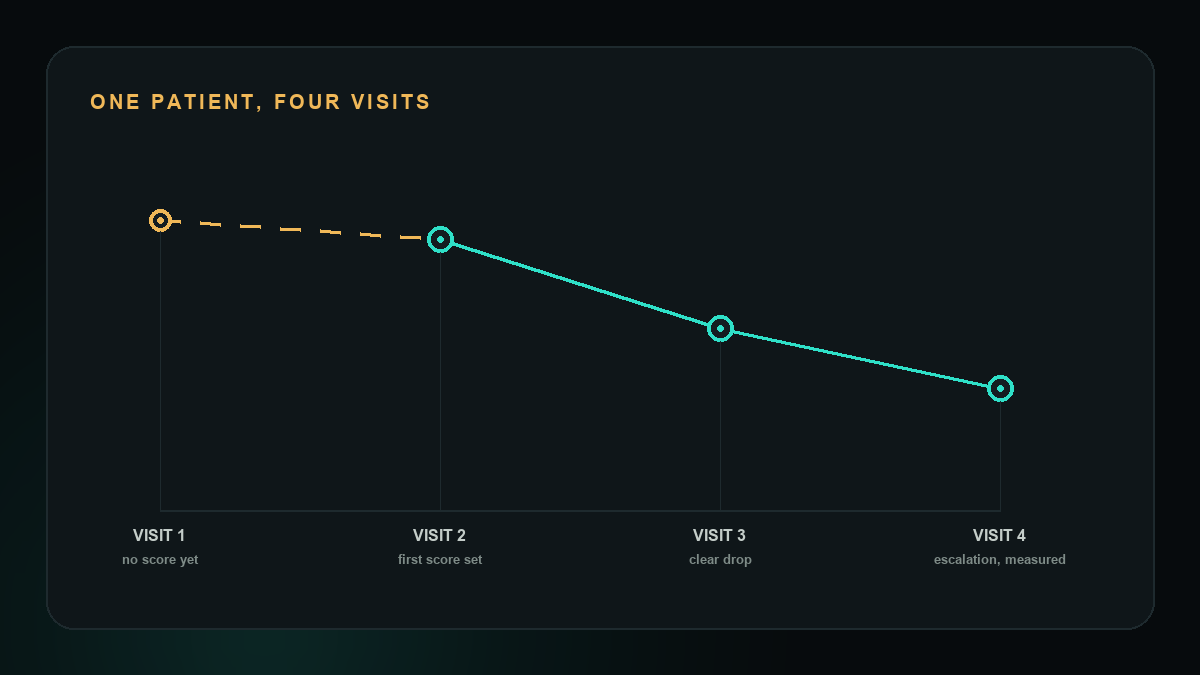
When we mapped a year of his follow-up visits for one patient, the pattern was clear. Visit after visit opened with the same explanation, the same reassurance, and a small medication adjustment. No score had been recorded since the second visit. He had been treating every visit as visit one, because nothing in his own records told him otherwise.
“I realised I was starting over every time because I had nothing on paper that told me I had already moved past that.”A Rheumatologist, After Reviewing a Year of Missed Scores
We made one change. A disease activity score, recorded at every visit and placed at the top of the chart before he walked in. Visit two confirmed the medication was being taken correctly. By visit three there was a number to compare against the first one, and the conversation moved for the first time in months. Visit four, when it came, was a genuine escalation, not a repeat of visit one with a different date on it. His consultations did not get shorter because he talked faster. They got shorter because each one finally had a different job to do.
Which visit your OPD is stuck on
Most practices are not missing all four visits. One visit, usually, is quietly standing in for the rest.
| What you notice | The visit you are likely stuck on | Where to look first |
|---|---|---|
| Patients ask the same basic questions at every visit | Visit One, repeating | Was the expectation set, or only the diagnosis explained |
| The plan keeps getting adjusted before it has been properly followed | Visit Two, skipped | A missing check on whether the basics are being followed at all |
| You cannot say whether this patient is better than three visits ago | Visit Three, missing | Nothing was measured and recorded in a comparable form |
| Advanced care conversations run long and still do not land | Visit Four, unsupported | No measured baseline exists for the deeper conversation to rest on |
- If I read my own notes for one patient’s last four visits, would I see four different jobs, or one job repeated four times?
- What is the one number I could start recording at every visit for my most common condition?
- Where in my own OPD does a deeper conversation keep running long without quite persuading anyone?
What changes once the four visits are distinct
None of this asks you to add a visit, or lengthen one. It asks each visit that already exists to do one job instead of all four.
Patients stop hearing the same explanation on a loop, because it already landed in visit one and visit two is doing something else. Measurement stops feeling like a lecture, because by visit three there is something real to compare. Advanced care conversations stop running long, because by visit four a number is doing some of the persuading instead of you.
I go into the complete version of this, the full visit-by-visit structure across a whole treatment relationship, in the pillar on cutting OPD time without cutting care, alongside the Visit Sequencing framework this piece has been applying throughout. Rebuilding that structure fully, in a way a team can hold without you watching every visit personally, is closer to eighteen to twenty four months in my experience. The first four visits done differently can start changing a single patient relationship within a month.
Your expertise should scale. Your exhaustion should not.
Questions doctors ask me about this
Do these four visits have to fall on fixed dates, like every two weeks?
No. The sequence is about order, not timing. A chronic condition might take four visits across two months to move through this arc. An acute one might move through all four inside three visits in two weeks. What matters is that each visit has one job, not that the calendar matches a template.
What if a patient skips visit two entirely and shows up for what should be visit three?
Treat the visit by its job, not by its number. If the basics were never confirmed, that visit is still functionally a visit two, whatever the patient calls it or however long it has been. Measuring before the basics are stable usually produces a number that is not worth much yet.
How is this different from the Visit Sequencing framework in the pillar?
Visit Sequencing names the five principles behind the order, education before expectation, stabilisation before optimisation, and the rest. This piece takes those principles and applies them to four concrete visits, so the framework becomes something you can see happen in a chart rather than something you only agree with in the abstract.
Can visit two or visit three be handled by a trained team member instead of me personally?
Often, yes, as I found when I wrote about the thirty day dependency test. Confirming adherence to a known plan, or recording a standard measurement, rarely needs your specific training. Diagnosis and the decision to go deeper usually still do.
Does this only work for conditions with a clear numeric score, like rheumatoid arthritis or diabetes?
A formal score makes visit three easier to run, but it is not required. A symptom diary, a photograph compared over time, or a simple checklist can serve the same purpose, a comparison against an earlier point rather than a fresh guess each time.
How do I know a patient is ready to move from visit two to visit three?
When the basics have held long enough that a measurement would mean something. Measuring too early, before the plan has had a fair chance to work, usually produces a discouraging number and an unhelpful conversation. Give the basics the time the condition genuinely needs first.
Does this overlap with Habit-Based Treatment, since both talk about what happens outside this one visit?
They sit beside each other. Habit-Based Treatment focuses on sustaining behaviour between visits. This piece focuses on what should happen, and in what order, across the visits themselves. Most practices need both working together.
None of this was ever about adding structure for its own sake. It was about letting each visit finally do the one job it was always meant to do, instead of quietly doing all four jobs, badly, every time.
Before your next OPD day, pick one patient and read back your own notes from their last four visits.
Would you find four visits, or the same one, repeated four times?
Want an honest read on where your patient journey stands?
I offer a free 15 minute strategy call. 15 minutes. Zero sales pressure. Just a clear, honest plan for your practice, built around the Super Doctor by BK system and the Patient Journey Design thinking behind it.
Read the full framework in OPD to Ecosystem
I wrote the complete version of this thinking, the visit-by-visit structure, and what it builds toward, in OPD to Ecosystem, across all nine chapters and the closing framework.

Bipin Koner works with specialist doctors across India, moving them from effort-based practice to structured medical ecosystems, through the Super Doctor by BK coaching system and the ideas in his book, OPD to Ecosystem.