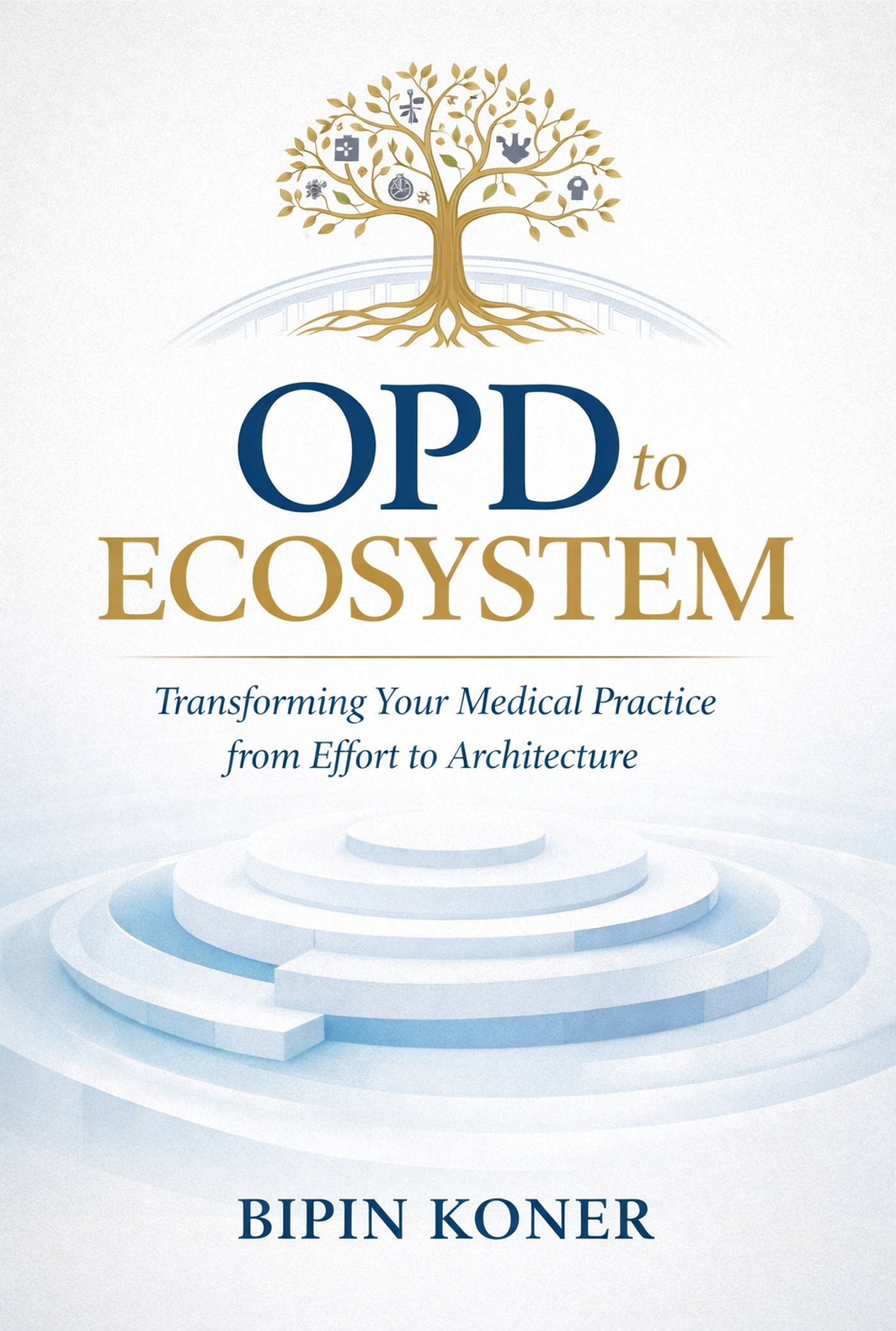
OPD to Ecosystem
If you’ve ever felt that everything slows down the moment you stop — this book is about the invisible shift that changes that. Read the first chapter free below, no email required.
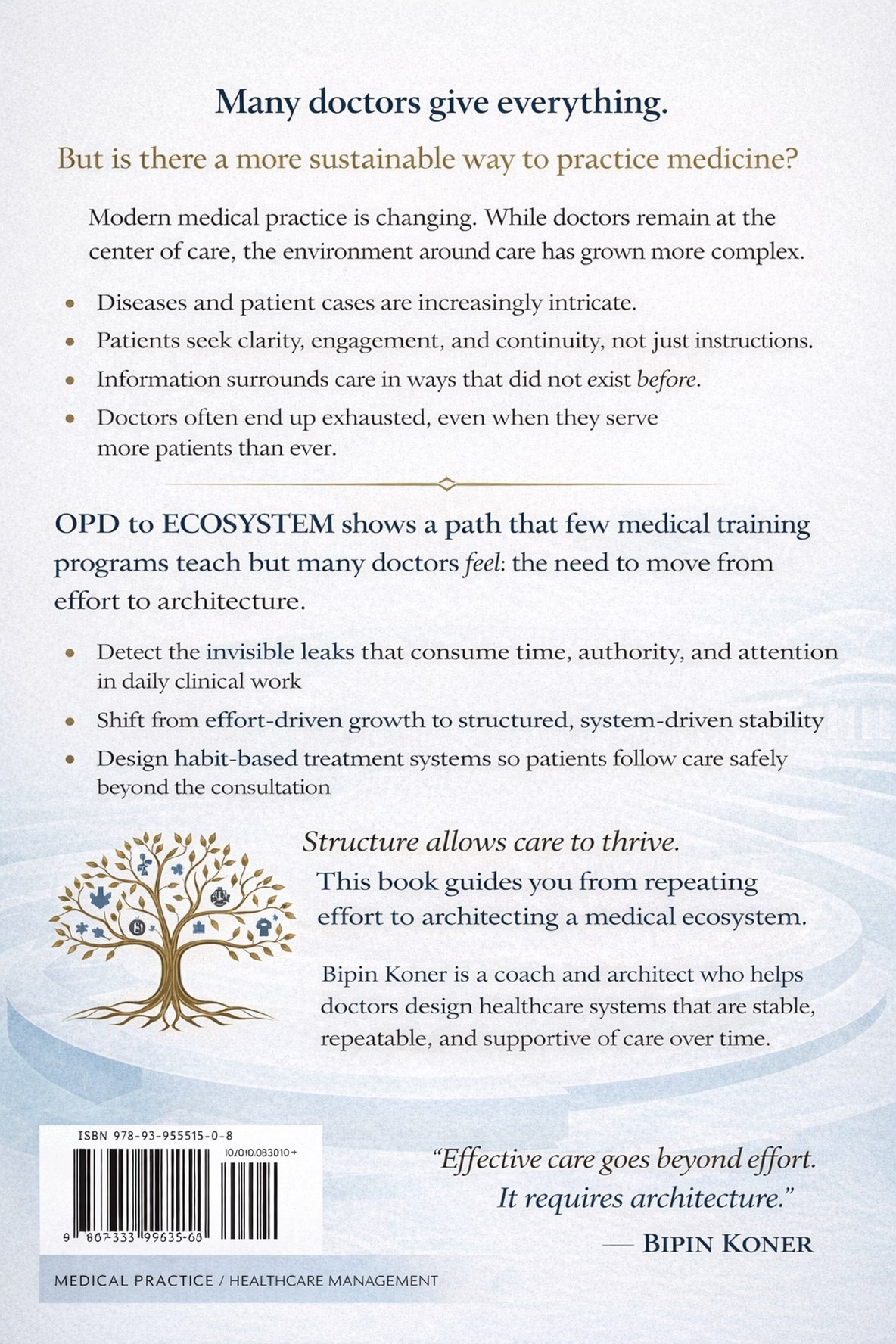
Many doctors give everything.
But is there a more sustainable way to practice medicine?
Modern medical practice is changing. While doctors remain at the center of care, the environment around care has grown more complex.
- Diseases and patient cases are increasingly intricate.
- Patients seek clarity, engagement, and continuity, not just instructions.
- Information surrounds care in ways that did not exist before.
- Doctors often end up exhausted, even when they serve more patients than ever.
OPD to Ecosystem shows a path that few medical training programs teach but many doctors feel: the need to move from effort to architecture.
- Detect the invisible leaks that consume time, authority, and attention in daily clinical work
- Shift from effort-driven growth to structured, system-driven stability
- Design habit-based treatment systems so patients follow care safely beyond the consultation
“Structure allows care to thrive.”
This book guides you from repeating effort to architecting a medical ecosystem.
“Effective care goes beyond effort. It requires architecture.” — Bipin Koner
Why Good Doctors Get Trapped Inside Their Own OPD
There is a strange reality inside modern medical practice. Many doctors are not struggling because they are not skilled enough. Many are not struggling because they do not work hard enough. In fact, most good doctors are already working more than they should.
From the outside, everything may look fine. The OPD may be running. Patients may be coming. The doctor may be respected. The clinic may be known in the locality.
But inside, many doctors silently feel one thing: “If I stop, everything slows down.” And this is where the real problem begins.
A full OPD does not always mean a strong practice.
Sometimes, a full OPD simply means the entire practice depends too much on the doctor’s personal effort.
At one level, this feels powerful. At another level, it becomes exhausting. Because when the doctor is the only engine, growth also becomes a burden. More patients mean more pressure. More reputation means more expectations. More income often comes with less time. More success starts demanding more personal sacrifice.
This is the invisible trap of effort-based practice.
The Doctor Is Growing, But the System Is Not
Most doctors try to solve this problem by doing more.
But after some time, many doctors realize that more activity does not always create more stability. The clinic may get more inquiries, but follow-up is weak. Patients may come once, but long-term engagement is missing. The doctor may give excellent advice, but patients do not follow it properly. The doctor may suggest tests, procedures, or treatment plans, but many patients delay decisions. The doctor may have deep expertise, but the market still sees them like “one more doctor” in the same category.
This creates frustration. The doctor starts thinking: “Maybe I need better marketing. Maybe I need more leads. Maybe I need more visibility. Maybe I need more social media content.”
Marketing may help, but only to a point. Because sometimes the real problem is not lack of marketing. Sometimes the real problem is that the practice has grown, but the ecosystem around the practice has not grown with it.
What Is Missing Between Consultation and Growth?
A medical practice is not only an OPD. An OPD is where the patient enters. But an ecosystem is where trust, understanding, follow-up, habit, team, technology, authority, and long-term care are built. This is the missing layer in many practices.
A patient comes with a problem. The doctor diagnoses. The doctor explains. The doctor advises. The doctor prescribes. The patient leaves. But what happens after that?
In many practices, this middle layer is weak. This is the space where patients get confused. This is the space where fear enters. This is the space where delays happen. This is the space where comparison starts. This is the space where patients disappear. This is the space where clinical advice fails to become patient action.
And when this middle layer is missing, the doctor has to compensate with more personal effort. The doctor has to explain again. The doctor has to convince again. The doctor has to follow up again. The doctor has to rebuild trust again. The doctor has to fight the same battle again and again. This is not only tiring. It is structurally inefficient.
The Hidden Leaks Inside a Medical Practice
Most doctors can see visible problems — low patient flow, staff issues, high rent, competition, marketing cost, patient bargaining, no-shows, low conversion for procedures or long-term treatments. But there are deeper invisible leaks.
- Time LeakThe doctor spends too much time on things that could have been handled by a trained system, team, content, or patient education process.
- Attention LeakThe doctor’s mind remains occupied with too many small decisions, interruptions, follow-ups, and operational issues.
- Authority LeakThe doctor has expertise, but the market does not fully understand the depth, specialization, or unique approach of the doctor.
- Trust LeakPatients trust the doctor inside the consultation, but outside the consultation they are influenced by family, fear, internet information, cost anxiety, and comparison.
- Follow-Up LeakThe clinic does not have a structured mechanism to bring patients back at the right stage of their treatment journey.
- Habit LeakThe doctor advises lifestyle correction, medicine discipline, testing, follow-up, or surgery preparation, but the patient fails to follow consistently.
- Team LeakThe clinic team works, but they are not trained to protect the doctor’s authority, educate patients, handle objections, and support treatment continuity.
These leaks do not always look dramatic. But over months and years, they silently reduce growth, income, reputation, patient outcomes, and the doctor’s peace of mind.
The Real Shift: From OPD Thinking to Ecosystem Thinking
OPD thinking asks: “How many patients came today?” Ecosystem thinking asks: “What happened before the patient came, during the consultation, and after the patient left?”
OPD thinking says: “I need more marketing.” Ecosystem thinking says: “I need stronger positioning, a better patient journey, a trained team, a follow-up system, habit-building support, and a practice model that does not depend only on my personal effort.”
This is the shift modern doctors must understand. Because the future of medical practice will not belong only to the doctor who works the hardest.
It will belong to the doctor who builds the strongest ecosystem around their expertise.
Why Marketing Alone Cannot Solve This
This is why many doctors run ads, create reels, build websites, or hire agencies, but still feel disappointed. The problem is not that marketing is useless. The problem is that marketing cannot carry the full weight of a weak ecosystem.
If the patient journey is unclear, marketing will only bring more confused patients. If the team is not trained, marketing will create more pressure. If the offer is not structured, marketing will create more price comparison. If the doctor’s authority is not clearly positioned, marketing will make the doctor look like everyone else. If follow-up is weak, marketing will keep filling a leaking bucket.
So before asking, “How do I get more patients?” a doctor must ask: “Is my practice ready to handle growth without exhausting me?” That is the real question.
The New Identity of the Doctor
For years, doctors were trained to become clinical experts. That remains the foundation. Without clinical excellence, nothing else matters. But in today’s healthcare environment, clinical excellence alone is not always enough to build a sustainable practice.
A modern doctor must also become the architect of a healthcare ecosystem. This does not mean the doctor should become less clinical. It means the doctor’s clinical value should be protected, amplified, and delivered through better systems.
This is the real movement from OPD to Ecosystem.
A Simple Self-Check for Doctors
- Is my practice still too dependent on my personal presence?
- Do patients understand my value before they meet me?
- Does my team know how to educate and guide patients properly?
- Do I have a structured follow-up system?
- Do patients continue their treatment journey with clarity?
- Do I have a clear positioning beyond my degree and specialty?
- Do I have a system for patient education, trust-building, habit support, and long-term care?
- If I take a break for a few days, does my practice continue smoothly — or does everything slow down?
If these questions make you think deeply, your problem may not be marketing alone. Your practice may be ready for an ecosystem shift.
The Purpose of OPD to Ecosystem
I wrote OPD to Ecosystem for doctors who are clinically capable, hardworking, and sincere — but who feel that their practice needs a deeper structure for the next level of growth.
This book is not about shortcuts. It is not about aggressive selling. It is not about turning healthcare into a mechanical business. It is about helping doctors build practices that are successful, meaningful, ethical, system-driven, and deeply connected to the lives they serve.
Because doctors should not have to choose between growth and exhaustion. They should not have to build success by sacrificing themselves completely. They should not have to remain trapped inside an effort-based model forever.
A doctor’s practice can become more than an OPD. It can become an ecosystem.
That is the shift. That is the journey. From OPD to Ecosystem.
If you are a doctor and this chapter felt close to your reality, take a few minutes to reflect. Maybe your practice does not need only more marketing. Maybe it needs a stronger system, a clearer patient journey, better positioning, better follow-up, better team alignment, and a more complete ecosystem around your expertise.
Want to go deeper than the book?
Book a free 60-minute strategy call with our team — a direct conversation about where your practice is right now, and what an ecosystem shift could look like for you.