Respect keeps a patient walking in. Direction keeps them walking back.
A senior orthopaedic consultant once called me, more puzzled than upset. A patient he had treated for four years, someone who had referred two relatives to him and left a warm review after almost every visit, had quietly started seeing a different doctor for the same knee.
He had not made an error. Nothing had gone wrong in the room. When they ran into each other later at a pharmacy, she still spoke about him warmly. She simply was not sure, six months into a flare-up that would not settle, what was supposed to happen next. So she went looking for someone who could tell her.
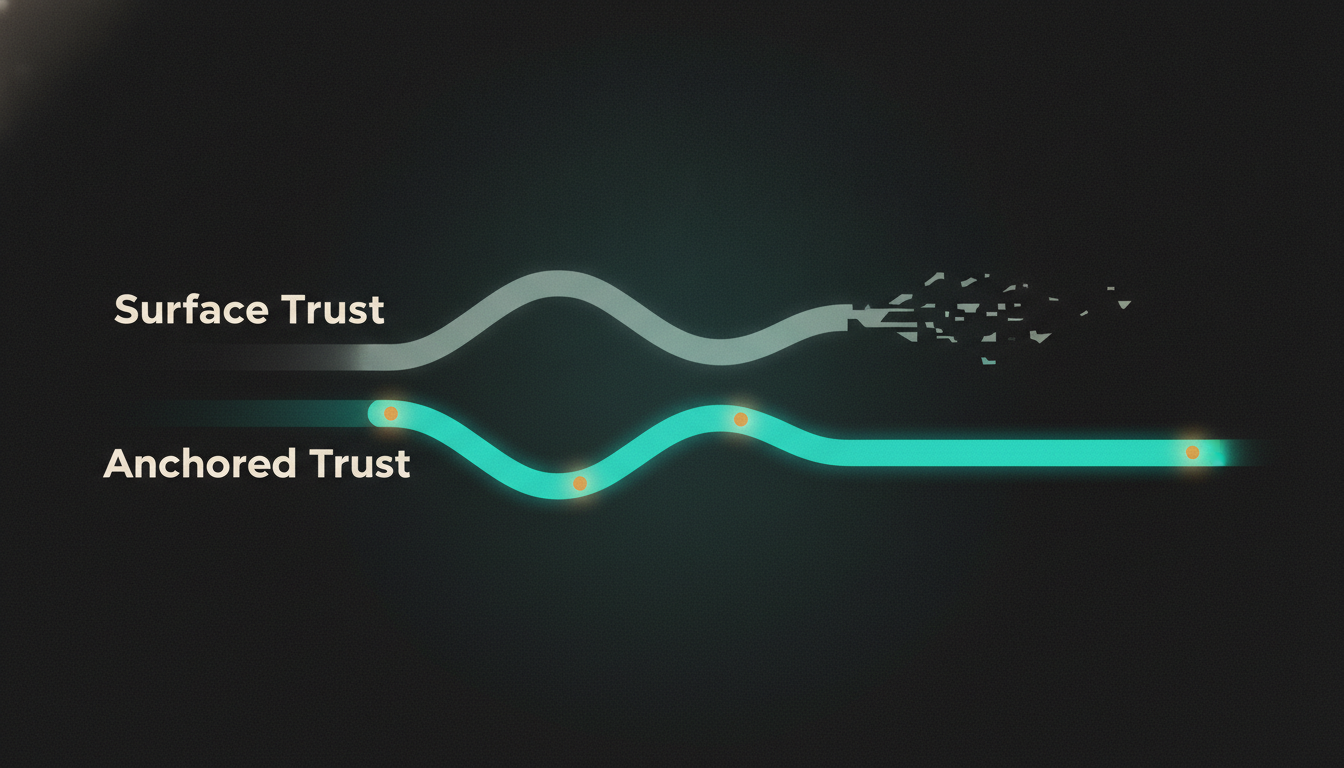
This is the second of the three invisible leaks I wrote about in every doctor’s practice, the Trust Leak. That article names the leak and shows the two layers of trust behind it. This one stays with the Trust Leak specifically and goes further into why it drains even well-run, well-liked practices, and what closes it.
This sits inside the wider Medical Practice Systems series on jhalak.co.in, alongside the piece on why patients forget what you explained ten minutes ago. If your leak looks more like instructions not sticking than the plan feeling unclear, that one is probably the closer read. This one is for the practice where the explaining is fine and the patient still drifts.
Anchored trust, one level deeper
The earlier article draws the line between Surface Trust and Anchored Trust. What it does not spend much time on is where anchored trust lives. It is not a single feeling a patient forms once, in the consultation room, and carries with them afterward. It is closer to a balance that moves at every touchpoint the practice has with that patient.
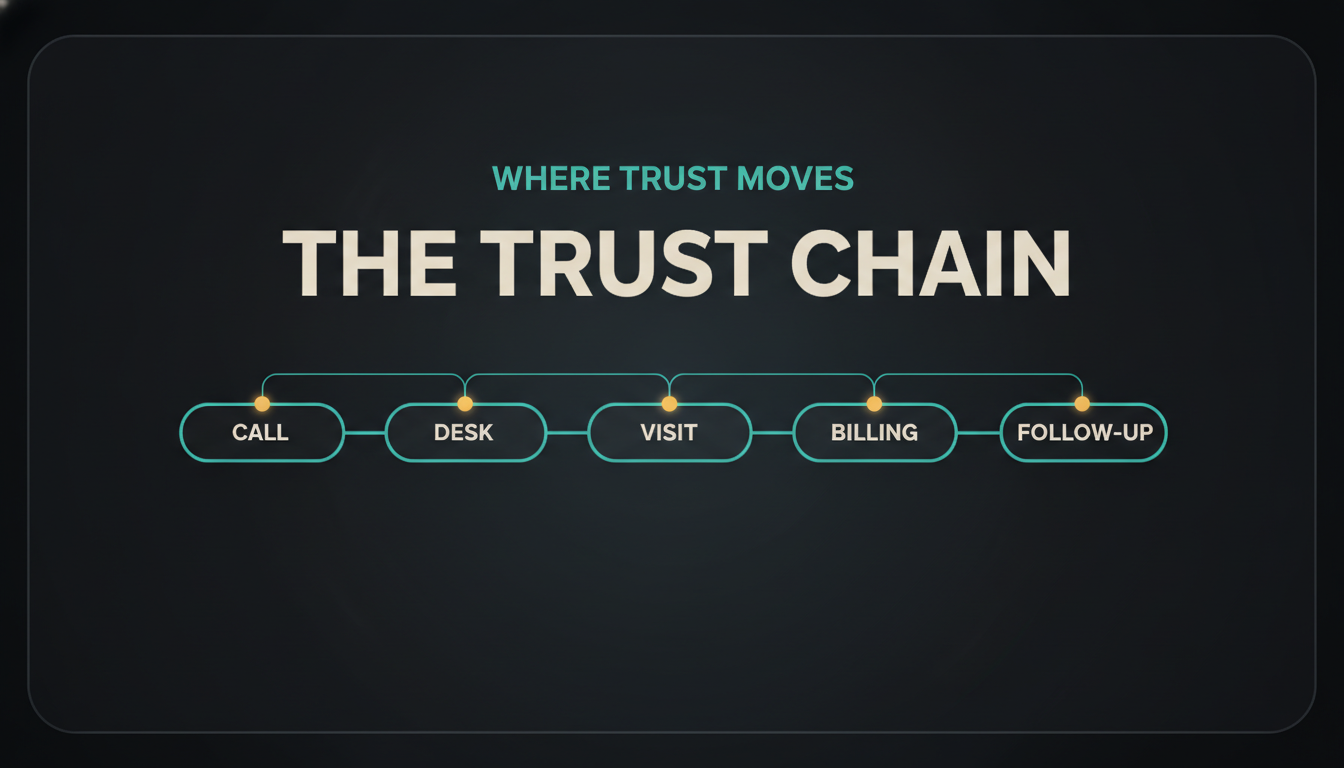
The consultation is one touchpoint. The reminder call before the next visit is another. The reception desk explaining a delay is another. The billing conversation is another. A colleague covering for you on a day you are away is another. Each one either adds a small deposit to anchored trust or spends one down, regardless of how strong the actual medicine is.
Most doctors manage the first touchpoint carefully and never look at the rest. That is not neglect. It is simply where training and attention were pointed. Nobody teaches a specialist to think about what the reminder call communicates.
Why patients rarely announce that they are leaving
A patient who is dissatisfied with a diagnosis will usually say so. A patient who is uncertain about direction almost never does. Uncertainty does not feel like a complaint. It feels like mild, private doubt, and most people do not think a private doubt is worth raising with someone they respect.
So instead of a conversation, you get a pattern. A follow-up gets pushed back by two weeks, then four. A message goes unanswered. A second opinion gets booked quietly, sometimes with a relative’s doctor, framed to everyone including themselves as “just to be sure,” not as a loss of confidence.
No complaint means no problem.
A missed follow-up is scheduling, not signal.
Finds out only when the patient does not come back at all.
The patient cannot describe what happens next.
A missed follow-up is often the first quiet sign of drift.
The exit was decided weeks before it became visible.
By the time a doctor notices the drift, the patient has usually already made the decision. The absence of complaints is not a stable measure of trust. In many practices it is the opposite. It can be the last thing that changes.
The gap between your words and your team’s words
Here is a gap most doctors never audit directly. Call your own reception desk, as a patient would, and ask when you should come back. Then compare that answer with what you said in the room three days earlier.
In practice after practice, the two answers do not fully match. Not because the team is careless, but because nobody gave them the same script you use in your head. The patient experiences this mismatch as inconsistency in the plan itself, even though the plan never changed. Only the description of it did.
| Touchpoint | Where anchored trust quietly breaks |
|---|---|
| First phone enquiry | Reception gives a general answer where the patient expected something specific to their case |
| Reception desk, in person | The return date or next step is stated differently from what the doctor said |
| Billing conversation | Cost is discussed with no visible link back to what stage of the plan it belongs to |
| Reminder message | Generic wording that does not reference the patient’s actual phase of treatment |
| A colleague covering for you | The covering doctor cannot see or does not repeat the plan in the same language |
None of these five require a bigger team or new software. They require the same plan, in the same words, available to everyone who touches that patient. Most practices never write the plan down anywhere the team can see it. It exists only inside the doctor’s memory, which means it cannot travel any further than the room it was spoken in.
Four ways to make the pathway visible
None of the four changes below need new staff or new technology. They need the plan to exist somewhere outside your head, in a form your team and your patient can both refer back to.
Name the phase out loud
Tell the patient, in plain words, which phase of treatment they are currently in and roughly how many phases the plan has. “We are in the stabilising phase, the second of three” gives a patient something concrete to hold, even without a guaranteed timeline attached to it.
Give one measurable checkpoint per visit
Not five markers. One the patient can track between now and the next visit, in terms they understand without you in the room to translate it.
Put the next two steps in writing
Not the full plan. What happens next, and roughly when. A written note outlives the conversation, and it is the same note your reception team can now read before they answer the phone.
Align your team’s script with your own
Five minutes with your reception team, once, on how to describe the general shape of a treatment pathway closes most of the gap in the table above. It is a small conversation that most practices have never had.
A short self-check
- If a patient called your reception desk today, would the answer match what you told them in the room?
- Is there a written version of the current plan anywhere outside your own memory?
- Which phase would a long-term patient say they are in right now, in their own words?
- What is the last thing that changes before a quietly dissatisfied patient stops returning?
- If a colleague covered for you tomorrow, could they describe the plan the same way you would?
If most of your answers point to “only in my head,” the fix is rarely a better bedside manner. Bedside manner is usually already strong in practices where this leak shows up. The fix is giving the plan a life outside the room, so it survives every touchpoint that is not you.
Rebuilding this properly, alongside the Attention Leak and the Habit Leak, is not a weekend fix. In my experience, bringing the doctor, the team and the systems fully into alignment takes 18 to 24 months. Early improvement in how a plan is communicated usually shows within a single quarter. Full structural change and early progress are not the same thing, and I would rather say that plainly than promise something faster. For the complete picture of all three leaks together, the original breakdown is the right place to start.
The complete framework is in the book
This article covers one leak in depth. I mapped the full sequence, all three leaks, the structural layers behind them, and the 48-point Doctor Clarity Scorecard, across all nine chapters on the book page.
Get it on Amazon IndiaAmazon USQuestions doctors ask me about this
Is the Trust Leak just a communication skills problem?
Usually not. Most doctors carrying this leak communicate well inside the room. The leak sits in what happens after the room, at the reception desk, in the reminder message, in the billing conversation, wherever the plan is described again by someone or something other than the doctor. Strong bedside manner does not automatically travel to those touchpoints.
How is this different from the Attention Leak?
The Attention Leak is about a patient forgetting what was said. The Trust Leak is about a patient remembering it clearly and still feeling uncertain about direction. A patient can retain every instruction perfectly and still not know what stage of treatment they are in. If instructions are the issue, the Attention Leak piece is the more relevant read.
Will writing the plan down make my authority look weaker?
In practice the opposite tends to happen. A written phase and a written next step read as structure, not uncertainty. What reads as weak to a patient is not knowing what is supposed to happen next, regardless of how confidently that uncertainty is delivered verbally.
My reception team already seems consistent. Could this leak still exist?
It can, because consistency and accuracy are not the same thing. A team can give the same answer to every patient and still be giving an answer that does not match what the doctor said in the room. The audit is simple: call your own desk and compare.
What is the fastest single change to make this week?
Write the next two steps down for every patient before they leave the room, in plain language, and hand your reception team the same note. It takes under a minute per patient and closes the largest single gap in the table above, the mismatch between what the doctor said and what the team repeats.
Want a second opinion on where your own patients quietly drift?
I hold a free 15 minute strategy call for doctors who want a clear, honest look at their practice structure. Zero sales pressure.
Book your free strategy call
Doctor brand architect. He works with experienced specialist doctors across India to move their practices from effort-based work toward structured medical ecosystems, using the 8P Business Model, disease-specific positioning, and Habit-Based Treatment. He is the author of OPD to Ecosystem and the creator of the Super Doctor system. More on doctor business growth or follow him on Instagram.