You already know the instruction was clear. That was never the question.
A doctor once told me, with some frustration, that he had explained a medication schedule three times to the same patient across three visits. Each time, clearly. Each time, in simple words. Each time, the patient nodded.
By the fourth visit, the schedule was still wrong.
His question to me was not “why is this patient not listening.” His question was “what is wrong with my explanation.” Neither question was quite right. The explanation was fine. The problem was that nothing in the room was built to hold what he said after the patient walked out of it.
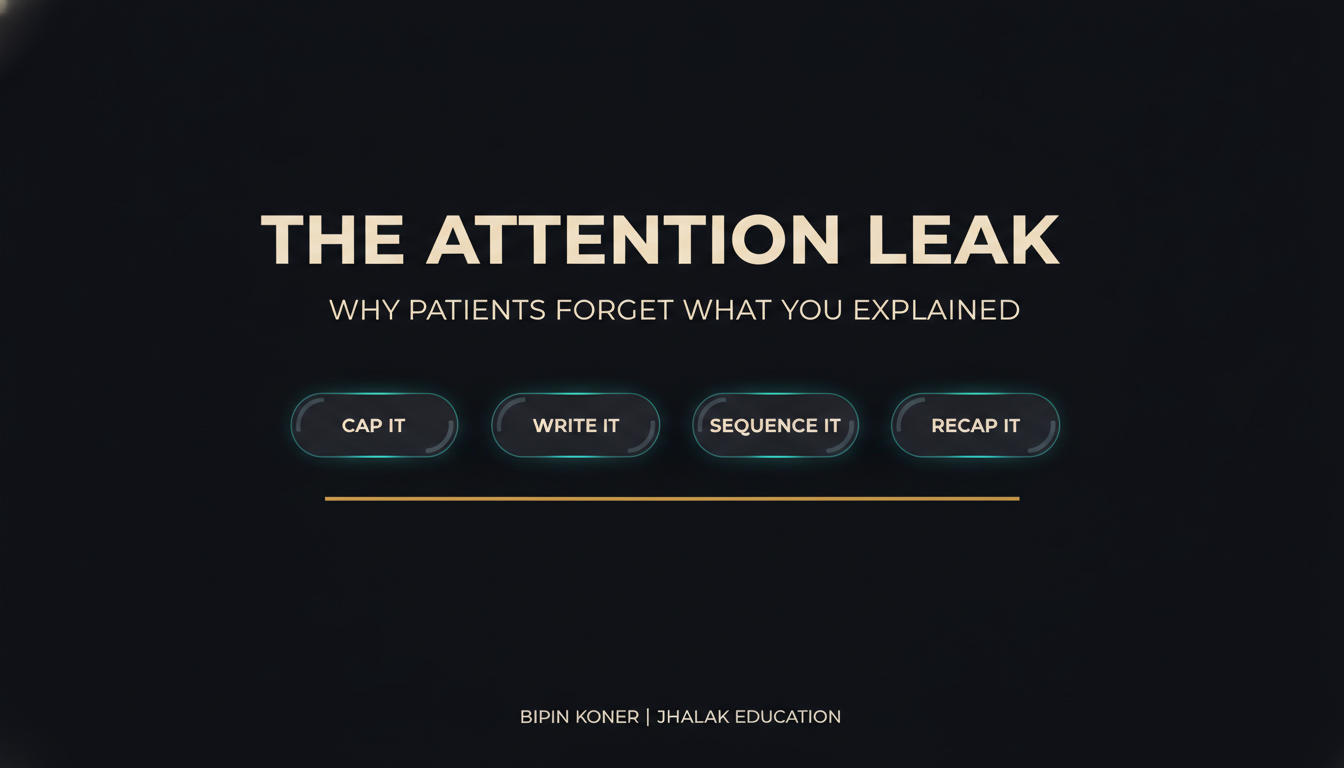
I call this the Attention Leak, and I wrote about it as one of three invisible leaks in every doctor’s practice. This article stays with that one leak and goes deeper into why it happens and what actually closes it.
The Explanation Illusion, one level deeper
Every capable professional carries a quiet assumption. If I explained it clearly, it must have been understood clearly.
The assumption is not careless. It is earned. You trained for years to explain difficult things simply, and most of the time, that skill works. It works well enough, in fact, that when it fails, the natural conclusion is that the patient was not paying attention, rather than that clarity and retention are two separate outcomes of the same conversation.
Research on doctor-patient communication has found that patients forget a large share of what they are told almost as soon as the consultation ends, and the share forgotten rises further when the information is delivered only in speech, with nothing written or visual to anchor it. That is not a comment on the patient’s intelligence or on your explanation. It is a comment on what a fifteen-minute verbal exchange can realistically carry.
The more experienced you become, the more this illusion strengthens rather than weakens. Experienced doctors explain faster, more fluently, and with more confidence, and fluency on the doctor’s side is often mistaken for clarity received on the patient’s side. It is a reasonable mistake. It is still a mistake.
What the patient brings into the room before you say a word
By the time a patient sits down in front of you, they have usually already made a number of decisions that day. What to tell their family about the visit. How to get time off work. Whether to bring a spouse or a parent. What they searched online the night before, and which of three contradictory answers they chose to believe.
Your explanation is not the first demand on their attention that day. It is often one of the last, arriving after the mental reserve for careful listening has already been spent elsewhere.
Add the emotional weight of a diagnosis, or the fear of one, and the room narrows further. Fear does not make people inattentive. It makes people selectively attentive, holding onto the most alarming phrase in the room and losing the structured steps that came after it.
She had listened. She was not careless or indifferent. The emotional headline of the visit was the part that stayed, and the practical steps that followed it did not survive the same journey home.
Two ways to run the same fifteen minutes
Most consultations are built, without anyone deciding it deliberately, as information delivery events. Diagnosis explained. Plan described. Advice given. The patient nods, thanks you, and leaves. Nothing in the structure of the visit was designed to make the information survive past the door.
A retention-focused consultation covers the same clinical ground, in roughly the same time, with one difference. It is designed around what the patient carries out of the room, not only what the doctor says inside it.
Every instruction is given equal weight.
Advice is spoken once, in full, and assumed to land.
Next visit re-explains most of it anyway.
Two priorities are named, the rest is secondary.
The two priorities exist somewhere the patient can see again.
Next visit builds on what stuck, not from zero.
The clinical content barely changes between the two. What changes is whether the visit assumed memory would do the work, or built something else to do it instead.
The five structural gaps behind the Attention Leak
Across practices, the same five gaps explain most of what gets forgotten. None of them are about how well you speak.
| The gap | What it looks like |
|---|---|
| Too many instructions per visit | Diet, medication, activity and warning signs all delivered in one pass, none marked as more urgent than another |
| No prioritisation hierarchy | The patient cannot tell you, afterward, which one thing mattered most |
| No memory reinforcement | Nothing outside the doctor’s voice repeats the instruction before the next visit |
| No sequencing across visits | Visit three re-explains what visit one already covered, because nothing carried it forward |
| No structured recap | The visit ends on a question, not on a summary of what the patient should now do |
None of these require more time in the room. They require the room to be organised around retention as a deliberate outcome, rather than an assumed side effect of a good explanation.
Building an attention architecture
Closing each gap is smaller than it sounds. None of the four changes below need new staff or new software. They need a decision, applied consistently.
Cap it at two
Before the patient leaves, they should be able to name two things without hesitating. Not six. Two. Everything else in the visit can still be said, but only two items get marked as the ones that matter most this week. The rest can wait for the next visit if it has to.
Put the two priorities somewhere visible
Written on a card, printed on a slip, sent as a message after the visit. It does not need to be sophisticated. It needs to exist outside the patient’s memory, because their memory is already carrying the rest of their day.
Sequence the next visit before you end this one
Decide, in the room, what the next visit is actually for. Is it a check on the two priorities. Is it the next stage of the plan. When the next visit has a defined purpose, it stops re-explaining the last one and starts building on it.
Close on a summary, not a question
“Any questions” invites silence, because most patients cannot yet tell what they failed to understand. A short spoken recap, in your own words, of the two priorities and when to return, gives the visit a final structured moment instead of an open one.
A two-minute self-check
- If you stopped a patient at the door right now, could they name your top two instructions?
- Is there anything in today’s consultation that also happened in the last one?
- Does anything survive this visit besides what the patient remembers?
- Did this visit end with a summary, or with silence waiting to be filled?
If most of your answers point to memory alone carrying the weight, the fix is not a better explanation. You already have that. The fix is giving the explanation somewhere to live after the patient stops listening to you and starts living their week.
The Attention Leak is the first of three. The other two, the Trust Leak and the Habit Leak, work differently and deserve their own read, which I cover in the full breakdown of all three invisible leaks.
The complete framework is in the book
This article covers one leak in depth. OPD to Ecosystem covers all three, the eight structural pillars behind them, and Habit-Based Treatment, across nine chapters.
Get it on Amazon IndiaAmazon USQuestions doctors ask me about this
Why do patients forget what I explained so soon after the consultation?
Research on doctor-patient communication consistently finds that a large share of what is said in a consultation is forgotten almost immediately, and more of it is lost when instructions are delivered only verbally rather than written or shown. Add the anxiety most patients carry into a consultation, and attention narrows to the most alarming point in the conversation, not the structured steps that followed it. This is not a reflection on the patient or on your explanation. It is a predictable outcome of memory carrying a job it was never designed to carry alone.
Does writing instructions down actually help, or is that just extra paperwork?
It helps, and it does not need to be paperwork. A written note survives outside the patient’s memory, which is the entire point. It does not need to be more than the two priorities from that visit, in plain language, on whatever format is fastest for your clinic to produce.
How many instructions can a patient actually retain from one visit?
Fewer than most consultations assume. Human working memory holds only a small number of new items at once, and that number drops further under stress or fear. Naming two priorities and treating the rest as secondary works with that limit instead of against it.
Is the Attention Leak the same as poor patient compliance?
No, and the distinction matters. Compliance failure is usually described as a patient choosing not to follow advice. The Attention Leak happens earlier than choice. The patient cannot follow an instruction they no longer accurately remember, regardless of how willing they are.
Will structuring the consultation like this make visits take longer?
Not in practice. Naming two priorities and closing with a recap take under a minute combined. What it usually removes is the ten minutes many doctors spend re-explaining the same instruction at the next visit, which is where the real time was being lost.
Want a second opinion on where your own consultations leak?
I hold a free 15 minute strategy call for doctors who want a clear, honest look at their practice structure. Zero sales pressure.
Book your free strategy call
Doctor brand architect. He works with experienced specialist doctors across India to move their practices from effort-based work toward structured medical ecosystems, using the 8P Business Model, disease-specific positioning, and Habit-Based Treatment. He is the author of OPD to Ecosystem and the creator of the Super Doctor system. Follow him on Instagram.