Your effort is not the problem. Three structural gaps are draining it before it reaches the patient.
Some of the most revealing conversations I have had with doctors happened after clinic hours, when the final patient had left and the staff had gone.
Something shifts at that hour. The shoulders relax. The professional voice becomes quieter. And somewhere between exhaustion and honesty, a sentence appears that I have heard, almost unchanged, from doctors across different cities.
The doctor who says this is rarely careless. Usually the reverse is true. Clinically capable. Responsible. Deeply committed to patients. The OPD is busy. The reputation is solid. Seen from the outside, everything seems to be working.
Inside, there is resistance. I have learned to notice that resistance, because it is rarely a problem of medicine. More often, it is a problem of structure.
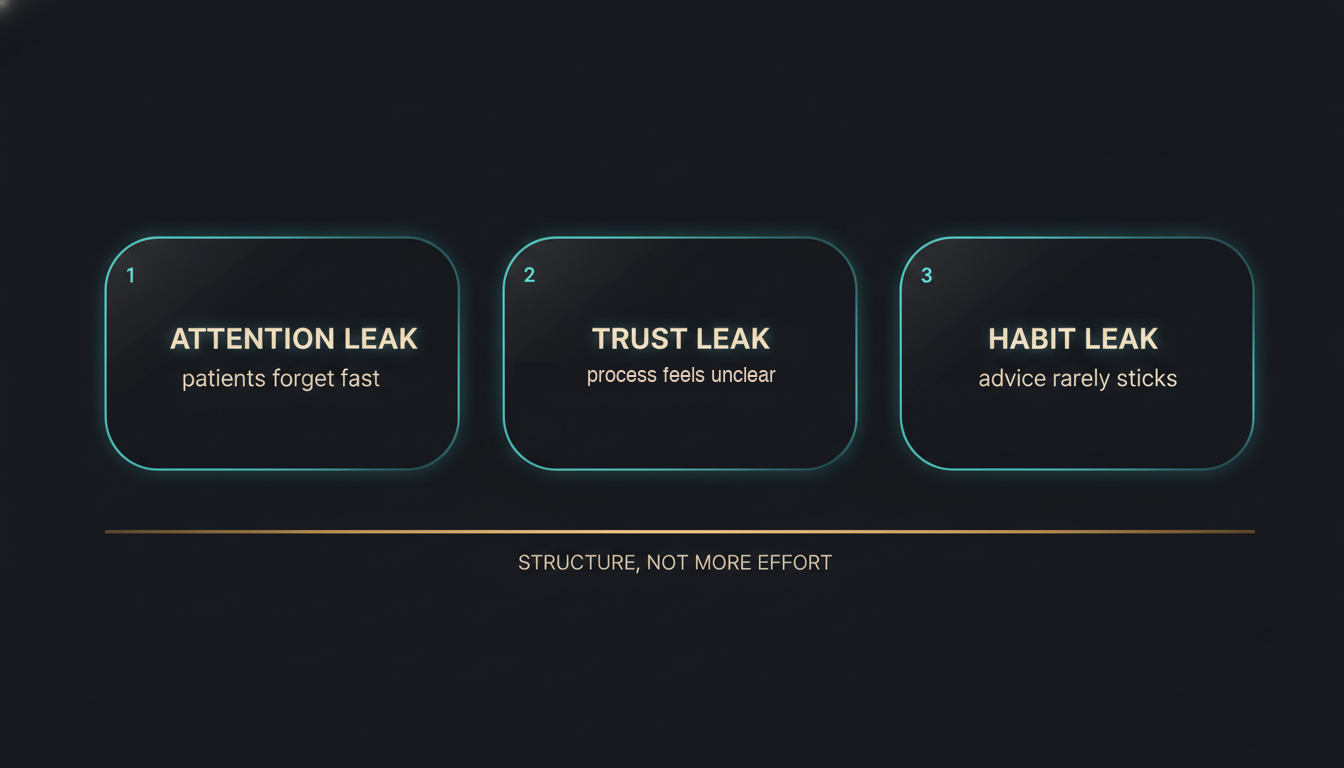
Three gaps explain much of it. I call them the three invisible leaks. They are not dramatic. They drain quietly, year after year, while the doctor works harder to compensate.

- Where your effort actually goes
- Why capable doctors remain unaware the longest
- Leak one: what the patient did not absorb
- Leak two: they trust you, not the plan
- Leak three: agreement in the room, relapse at home
- Both sides are sincere. The gap remains.
- Why this feels like burnout
- Why marketing makes a leaking practice worse
- What changes when the leaks close
- Where to begin this week
- Questions doctors ask me about this
Where your effort actually goes
Think of your professional energy as a reservoir. Into it goes your time, your clinical judgement, your emotional presence, and your attention. All of it enters the clinic each day.
When the structure around the patient is strong, that effort becomes three outcomes. Patients understand what matters. Trust stays steady. Behaviour outside the clinic stays consistent.
When the structure contains gaps, some of that effort quietly disappears. Not suddenly. Not in one terrible week. It leaks slowly enough that nobody notices the waste, only the tiredness.
So the doctor responds in the most natural way and gives more. Longer hours. More explanation. Personal follow-up calls. Effort rises. The reservoir continues to drain.
Why capable doctors remain unaware the longest
These leaks are often most visible in strong practices, not weak ones. That surprises many doctors when they first understand it.
A capable doctor can carry substantial structural weakness. You can explain something again. You can reassure a doubtful patient. You can stay another hour. You can remember six follow-up details because your memory is dependable.
Each action hides a weakness in the system. Your competence performs the work the structure should be performing. I call this the Competence Trap, and it explains why these gaps can remain invisible for ten years.
Weak systems reveal themselves quickly, because nobody is strong enough to carry them. Yours may remain hidden because you have been carrying it personally.
Leak one: what the patient did not absorb
It does not look like conflict. It does not look like incompetence. Most often, it looks like repetition.
I have sat in consultation rooms where communication was genuinely strong. The explanation was organised. The language was simple. The care was obvious. Weeks later, the same patients returned having completed only part of the plan.
At first this looks like a patient problem. It is rarely that simple.
The Explanation Illusion
Every capable professional carries one quiet assumption. If I explained it clearly, surely it was understood clearly.
A consultation is not a classroom. It is an emotional setting. The person before you may carry anxiety, a diagnosis they fear, a cost not discussed with family, and opinions from three relatives. Clarity delivered and clarity absorbed are not the same thing.
I once watched a doctor explain a treatment plan in three simple steps. The patient nodded throughout and asked two sensible questions. At the next visit, one step had been followed, and even that one incompletely. The doctor was confused. He had been clear. He was right about that. Clarity was never the problem.
Your patient is not short of information
Today’s patient is not deprived of information. They are surrounded by it. Before entering your clinic, many have searched symptoms, watched videos, spoken to family, and collected conflicting opinions.
Then, inside one short consultation, they receive a diagnosis, medication timing, dietary advice, lifestyle instructions, warning signs to notice, and a follow-up date. Something will be lost. Not deliberately. Human working memory can hold only a few new items at once, and fear reduces attention even further.
If a patient is frightened by a test result, they may remember only the frightening part. The six practical instructions that followed may never fully register.
How it appears in your day
- You explain the same instruction again during the next visit
- You hear “I forgot that part” or “I thought that was optional”
- Lifestyle advice is followed briefly, then gradually abandoned
- Medication timing becomes inconsistent for no clear reason
- Consultations run ten minutes longer than they really need to
Ten extra minutes for one patient feels small. Ten extra minutes across a full OPD, every day, over many years, becomes a meaningful part of your professional life.
The specialist who explained brilliantly
I worked with a specialist whose patients praised his clarity. He used diagrams. He encouraged questions. He never hurried a consultation.
Adherence still remained inconsistent. Lifestyle changes faded. Medication timing mistakes were common. Follow-up investigations were repeatedly postponed.
He did not blame patients. He improved his explanations. Longer consultations. Simpler words. More examples. The pattern improved for a while, then returned.
So I asked him one question. What happens after the patient leaves your room?
He stopped. Beyond the prescription, there was nothing. No summary of the two actions that mattered most. No clear priority. No reminder between appointments. The consultation was strong. The memory support around it did not exist.
We changed small things. Six instructions became two priority actions. Verbal advice gained a written order. Assumed retention became a defined checkpoint. Adherence improved steadily from there. His explanation had always been strong. The structure holding it was missing.
I asked her exactly what she needed to change during that week. She paused, then mentioned something about diet, and something about timing. She had listened sincerely. The emotional weight of the consultation buried the practical detail. She did not lack intention. She lacked structured recall.
- How many decisions am I asking a patient to make in one visit?
- Which instruction gets forgotten most frequently?
- Do I rank instructions, or present every instruction as equally important?
- How much of today’s consultation repeated what I said last time?
- What supports the patient once they leave my room?
Leak two: they trust you, not the plan
This leak is easy to misread, because it has little to do with your reputation.
I am not describing poor reputation or any ethical issue. Most doctors I work with are well respected. Patients describe them as skilled, caring and knowledgeable. Those same practices can still lose patients halfway through treatment.
The patient does not distrust the doctor. The patient feels uncertain about the pathway because it is not visible.
Two layers of trust
| Surface Trust | Anchored Trust |
|---|---|
| “The doctor is good.” | “I know what happens next.” |
| “I like the doctor.” | “This plan has a clear structure.” |
| “He explains well.” | “I understand how progress will be measured.” |
| Built on personality and reputation | Built on predictability |
| Brings a patient into your clinic | Keeps a patient within your care |
In many practices, surface trust is strong while anchored trust is fragile. That combination looks healthy until the patient stops returning.
The five questions your patient never asks aloud
Medicine cannot guarantee an outcome. Patients understand that better than we sometimes assume. What they need instead is structural predictability, and silently they ask five questions.
- What happens next?
- How long is this likely to take?
- How will I know whether it is working?
- When should I become concerned?
- When exactly should I return?
When these questions remain unclear, anxiety grows. An anxious patient rarely complains. They drift. And when your reception team describes the process differently from you, the patient experiences separate appointments instead of one guided journey.
How it appears in your day
- Patients switch doctors sooner than their clinical progress would justify
- Price becomes a bigger discussion, because unclear value makes cost more visible
- You repeat reassurance often: do not worry, things are under control, trust the process
- Second opinions increase, not necessarily from doubt about you, but from a weak sense of direction
When structure is weak, patients look for reassurance elsewhere. When structure is strong, reassurance is already built into the journey, and nobody needs to keep supplying it verbally.
The respected doctor with low retention
A physician I worked with had a strong reputation locally. New patients came steadily. Nearby clinics referred people to him.
Long-term continuity, however, remained poor. Patients attended once or twice and disappeared. Some returned months later with the same unresolved problem.
He assumed cost was the reason, or perhaps poor discipline. When we mapped the patient journey, we saw something different. His diagnosis was clear and the prescription appropriate, but the roadmap existed only in his head.
Patients left knowing which medicine to take. They did not leave knowing what improvement should look like, how it would be measured, which phase of care they were in, or what would happen if progress slowed.
We added four simple elements. Defined treatment phases. A follow-up timeline spoken clearly. Measurable checkpoints. A written note of the next two steps. Retention improved over the months that followed. His clinical skill never changed. The pathway became visible.
She was not doubting his ability. She was uncertain about direction. A patient can respect you completely and still feel structurally lost.
- Do my patients know which stage of treatment they are currently in?
- Is improvement described using terms they can actually measure?
- Do they know the next two steps, or only the next prescription?
- Does my team explain the pathway in the same way that I do?
- Do patients feel guided, or do they feel they are attending separate appointments?
Leak three: agreement in the room, relapse at home
This is where behaviour meets medicine, and where I have seen quiet frustration among capable doctors.
You explain properly. The patient agrees honestly. The prescription is correct. Weeks later, progress has stalled. The problem is rarely a lack of knowledge. It is inconsistency.
Consider how much modern medicine depends on what patients do outside your clinic. Diabetes. Hypertension. Obesity. Chronic pain. Migraine. Post-surgical rehabilitation. Medication matters in all of them. Behaviour matters more.
Sleep. Food. Activity. Medication timing. Stress. When these fluctuate, clinical outcomes fluctuate with them, and no prescription can hold them steady by itself.
The Indian data deserves attention. Studies on medication adherence across the country report non-adherence ranging from 18.7% to 74%, depending on the condition and setting. A national survey of non-communicable diseases found that only around a quarter of rural patients with diabetes were regularly taking their prescribed oral medication.
Intention is not habit
Doctors often assume that once patients understand why change matters, behaviour will follow. Understanding and doing are separate. Agreement inside the consultation is not consistency inside the home.
Behaviour often runs in loops. A trigger, followed by a routine, followed by a reward. Stress leads to comfort food, which creates temporary relief. A morning alarm leads to taking a tablet, which creates peace of mind.
When you ask a patient to change, you are asking them to interrupt an established loop and create a new one. That is possible. It is also demanding, and effort without reinforcement fades. Daily life competes with medical instruction. Work, family, stress and mood all push against it.
Almost every patient knows that exercise helps and excess sugar harms. Knowledge was never the only missing element.
The chronic disease specialist
I once worked with a physician who treated metabolic disorders. His protocols were strong and evidence based. He invested real time in lifestyle education during every consultation.
His outcomes still plateaued. HbA1c improved and later stalled. Weight reduced and returned. Medication changes became reactive rather than planned.
When we examined his system, one pattern explained most of the frustration. Every behavioural change depended on the patient’s self-discipline between appointments. There was no tracking, no small milestone, no checkpoint, and no structured accountability.
We introduced three elements. Visible behaviour tracking. Small defined goals instead of broad lifestyle advice. Structured reinforcement between appointments. Not every patient changed completely. Overall consistency improved, and the doctor’s frustration reduced, because outcomes no longer depended on willpower alone.
There was no defiance in her voice. Only tiredness. Each attempt had lasted a few weeks before stress or a disrupted routine ended it. She believed the failure reflected personal weakness. She had no accountability, no recorded small wins, no reminders, and no visible markers of progress. She did not lack intention. She lacked a framework.
That cycle carries a cost beyond the clinical one. Relapse becomes shame. Shame reduces honesty at the next follow-up. You begin treating a version of the truth.
- How much of my treatment outcome depends on behaviour outside the clinic?
- Do I measure behaviour, or only biological and clinical markers?
- What reinforces the patient between one consultation and the next?
- Where am I expecting willpower to do the work that structure should perform?
- Before I call a patient non-compliant, what support was actually present?
Both sides are sincere. The gap remains.
It helps to look from both sides of the consultation table at the same moment.
Trained for years. Carries the responsibility seriously. Explains with care. Repeats with patience.
“Why do they not follow what I explain?”
Not arrogance. Concern. You know exactly where uncontrolled diabetes can eventually lead.
Nods sincerely. Agrees completely. Leaves genuinely intending to follow the recommended plan.
“Why can I not manage this properly?”
Not defiance. Human limitation. Routine, stress, pressure and old habits intervened.
The doctor sees non-adherence. The patient feels inadequate. Both are sincere. Both are genuinely trying. The gap remains.
That taught me something I now believe. When both sides are sincere and the outcome still remains inconsistent, the problem is rarely character. More often, it is structure.
If instructions are clear but attention is overloaded, information disappears. If care is competent but progress remains invisible, uncertainty grows. If advice is sound but behaviour has no support, relapse becomes predictable. None of this is a moral failure on either side of the consultation table.
Why this feels like burnout
As I studied these three leaks across practices, I noticed a second effect nobody had named for me. Emotional strain. Not collapse. Not withdrawal. A slow depletion.
Then the connection became obvious.
| When this leaks | You are required to supply more | And it costs you |
|---|---|---|
| Attention | Repetition | Time and voice, at every visit |
| Trust | Reassurance | Emotional energy you cannot bill |
| Habit | Persuasion | The sense that you are constantly pressing uphill |
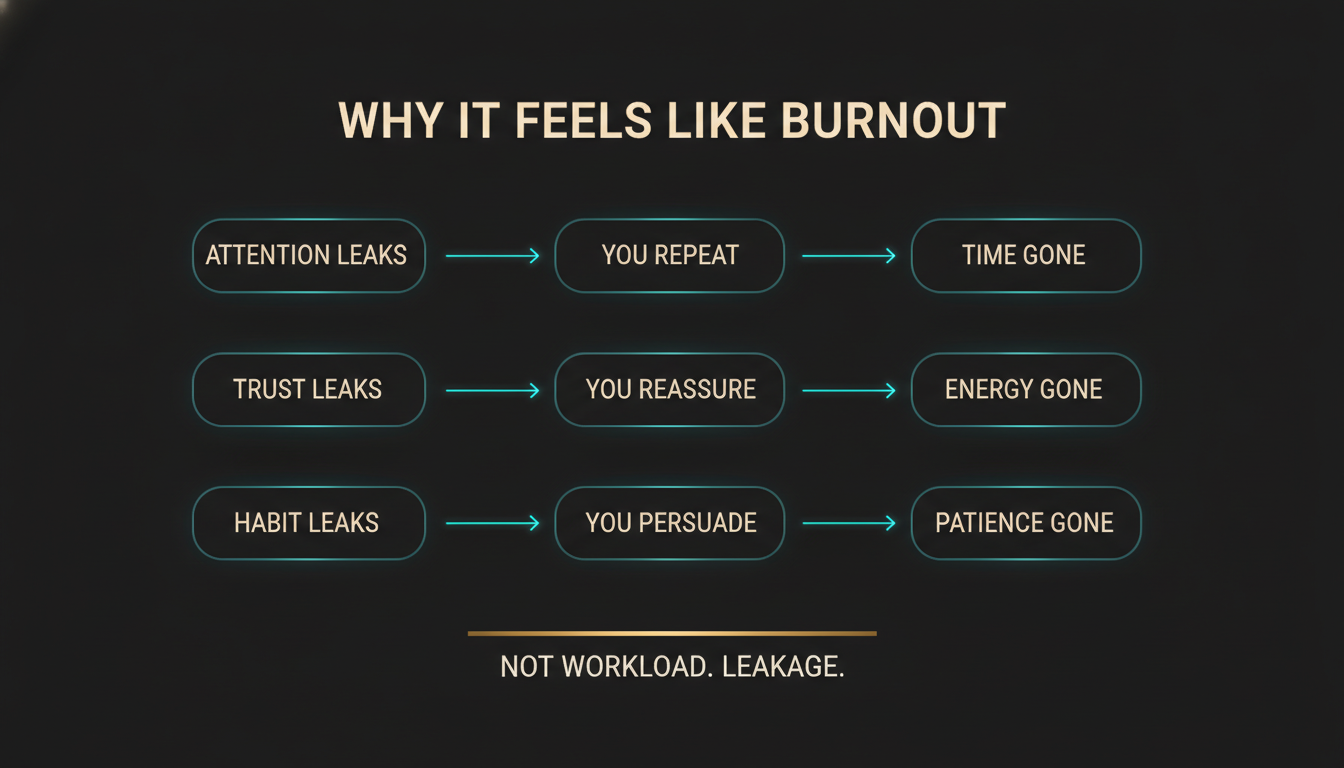
Repetition, reassurance and persuasion all draw from the same internal reserve. Continue for years and the result is structural fatigue. Many doctors call this burnout and assume patient volume is the cause.
This is why one senior consultant once told me he was not burnt out, only tired in a way that rest never repaired. Rest restores energy. It cannot repair a structural gap, because the same gap is waiting again on Monday morning.
Why marketing makes a leaking practice worse
When a practice feels unstable, the first instinct is often visibility. More reach. More enquiries. More patient footfall.
Here is the difficulty. Marketing amplifies a structure. It does not repair the structure.
Send more patients into a practice leaking attention, trust and habit, and every leak expands. More instructions are forgotten. More patients disappear after two visits. More advice fails to become behaviour. Costs rise, the OPD becomes heavier, and outcomes barely improve.
Do not increase traffic before repairing the road. Marketing, patient counselling and operations must move together, and marketing happens to be the easiest of the three things to buy.
What changes when the leaks close
Closing these gaps does not require greater intensity from you. It requires adjusting the design around you. When that happens, your effort begins to compound instead of disappearing.
The same consultation creates more clarity. The same treatment plan builds more stable trust. The same advice supports behaviour for longer. Nothing about your clinical ability has changed. The structure carrying your competence has. Your effort finally begins reaching the patient with less loss each day.
Something quieter changes too. You feel less pressure to convince. The patient feels less shame about struggling. The consultation becomes less about persuasion and more about guidance.
The goal was never to eliminate human imperfection from medicine. The goal is to reduce friction. Less friction creates steadier outcomes, and steadier outcomes reduce the burden placed on you.
Where to begin this week
Do not correct all three leaks at once. Choose the one that made you slightly uncomfortable while reading, because that is usually the honest starting point.
| If this describes your clinic | Your main leak is | Change one thing |
|---|---|---|
| Patients forget or misunderstand instructions | Attention | Reduce each visit to two priority actions, written down |
| Patients like you but stop returning | Trust | Tell every patient their next two steps and how progress will be measured |
| Patients agree but behaviour does not last | Habit | Add one checkpoint between visits that somebody other than you owns |
One change, sustained for a full quarter, can teach you more about your structure than any audit.
I should be transparent about the timeline. Rebuilding the doctor, the systems, the personal brand and the business together takes 18 to 24 months in my experience. Early progress appears much sooner. Early progress and complete transformation are not the same thing, and I would rather make that clear from the beginning.
The full framework is in the book
These three leaks form the diagnostic chapter. OPD to Ecosystem covers the eight structural pillars, patient journey design, and Habit-Based Treatment across nine chapters.
Get it on Amazon IndiaAmazon USQuestions doctors ask me about this
Why is my clinic not growing even though I work harder every year?
In most cases it is neither a skill problem nor a demand problem. Effort can cover structural gaps for years, which is exactly why those gaps remain invisible until exhaustion forces you to ask the question. Examine the three leaks before examining your marketing budget.
How do I know which of the three leaks I have?
Most practices contain all three, although one usually dominates. If patients forget instructions, begin with attention. If they like you but stop attending, begin with trust. If they agree but behaviour does not follow, begin with habit. The table above narrows it quickly.
My patients say they cannot follow the diet. Is that mine to solve?
Their behaviour is not your responsibility. The structure surrounding that behaviour is your opportunity. A patient with no tracking, no small goals and no checkpoint depends entirely on willpower, and willpower changes with mood. Give behaviour a framework and adherence becomes less dependent on how their week felt.
Why do patients stop returning even when they respect me?
Because respect is surface trust, and surface trust becomes fragile under uncertainty. If patients cannot describe the next two steps or explain how progress will be measured, they lose a visible reason to return once symptoms improve. That is the Trust Leak.
Is this burnout, or is it something else?
Ask one question. Does rest repair it? Genuine overwork usually improves with a break. Leakage-driven fatigue returns, because the repetition, reassurance and persuasion start again on Monday. If rest does not repair it, examine the structure rather than only the schedule.
Should I invest in marketing to correct a slow practice?
Only after checking for leaks. Marketing amplifies whatever structure already exists. If patients who already know you are not returning or are not following advice, more visibility simply multiplies the same losses at a higher cost.
Can a small solo clinic do this, or does it require a large hospital?
Architecture has nothing to do with size. A solo doctor with a clear follow-up sequence can close more of the Habit Leak than a large hospital operating through improvisation. The requirement is clarity, not infrastructure.
How long before I see a difference?
A single leak can begin closing within one quarter once you redesign the touchpoint creating it. Rebuilding the doctor, the systems and the business together takes 18 to 24 months. Anyone promising a complete rebuild in 30 days is describing a campaign, not an ecosystem.
These leaks are not character flaws or clinical failures. I have seen them most clearly inside busy, well-run practices led by experienced specialists. They appear wherever effort is quietly compensating for structure.
Once you can see them, you can redesign them. That is the encouraging part.
Want an honest read on where your practice leaks?
I hold a free 15 minute strategy call for doctors who want a clear view of their own structure. Zero sales pressure. An honest plan you can act on.
Book your free strategy call
Doctor brand architect. He works with experienced specialist doctors across India to move their practices from effort-based work toward structured medical ecosystems, using the 8P Business Model, disease-specific positioning, and Habit-Based Treatment. He is the author of OPD to Ecosystem and the creator of the Super Doctor system. Follow him on Instagram.